
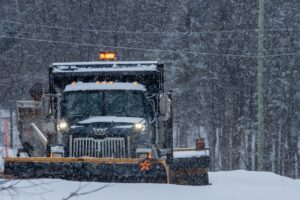
When you approach a stopped squad car, ambulance, fire truck, tow truck, road maintenance vehicle, or other work vehicle with its lights flashing, Minnesota law requires you to move over a lane if you safely can, or slow down if you can’t. Since July 1, 2023, the same rule covers any stalled car with its hazard lights on or people standing outside it. A moving snowplow is not covered, but you still have to stay back and drive for the conditions.
| Question | Answer | Source |
|---|---|---|
| Which vehicles? | Emergency vehicles, tow trucks, freeway service patrol, road maintenance (including stopped plows), utility, construction, postal, solid waste, and recycling vehicles, stopped with lights on | Minn. Stat. § 169.18, subd. 11(a) |
| Stalled cars too? | Yes, with hazards on or people visibly outside, since July 1, 2023 | § 169.18, subd. 11a; Laws 2023, ch. 68, art. 4, sec. 46 |
| What if I can’t change lanes? | Slow to a reasonable and prudent speed until you are fully past | § 169.18, subd. 11(d) |
| Penalty | Petty misdemeanor, fine up to $300; misdemeanor if you endanger anyone | § 169.89, subds. 1-2 |
| Extra cost for not slowing | Speed surcharge equal to the fine, at least $25 | § 169.14, subd. 3(b) |
| Recent enforcement | 159 Move Over citations in the 2026 summer campaign | DPS, Oct. 1, 2026 |
What does Minnesota’s Move Over law require?
The safest way to pass a stopped vehicle depends on how many lanes are available in your direction. Under Minn. Stat. § 169.18, subd. 11:
- Two lanes in your direction: move to the lane farthest from the stopped vehicle.
- Three or more lanes: leave a full empty lane between you and the stopped vehicle.
- Only one lane, or no safe gap: slow to a speed that is “reasonable and prudent under the conditions” until you have completely passed.
Each step applies “if it is possible to do so.” The law covers any “street or highway,” so it reaches two-lane rural roads too. There, the duty is to slow down.
If you can safely move over, you must. When changing lanes isn’t safe or possible, slow down.
Which vehicles count, and does the law cover snowplows?
The law protects nine kinds of “authorized vehicles” when they are parked or stopped on or next to the road with emergency, flashing, or warning lights on:
- Authorized emergency vehicles, including squad cars, fire trucks, and ambulances
- Tow trucks
- Freeway service patrol vehicles
- Road maintenance vehicles
- Utility company vehicles
- Construction vehicles
- Postal service vehicles
- Solid waste (garbage) trucks
- Recycling trucks
Snowplows are covered when they are stopped on or next to the road with their warning lights on. They count as road maintenance vehicles. A plow that is moving is outside this subdivision, because the law applies to vehicles that are “parked or otherwise stopped.”
What about a plow that’s moving?
No Minnesota statute sets a following distance or passing rule just for plows. The general rules do the work. You may not follow any vehicle more closely than is “reasonable and prudent” (§ 169.18, subd. 8(a)), and you may not drive faster than conditions allow (Minn. Stat. § 169.14).
MnDOT’s advice is specific: stay at least 10 car lengths behind the plow, and don’t drive into the snow cloud. Plows turn and exit often, and they can cross the centerline or travel partly in your lane. More on staying safe on winter roads and our winter driving tips for Minnesotans.
When a plow is stopped, the Move Over law applies. When it’s moving, drivers still have to keep a safe following distance.
What changed in 2023?
The 2023 transportation law made two important changes (Laws 2023, ch. 68):
- Stalled cars. Since July 1, 2023, the move-over duty also applies to any stalled or disabled vehicle with its hazard lights on or people visibly outside it (§ 169.18, subd. 11a). That includes a neighbor changing a flat on the shoulder.
- Postal vehicles. The law added postal service vehicles to the list of authorized vehicles.
The law carries the name of State Patrol Cpl. Ted Foss. According to the Department of Public Safety, he was conducting a traffic stop on the shoulder of Interstate 90 on Aug. 31, 2000, when a passing vehicle hit and killed him. The Move Over subdivision became law in 2001, and DPS calls it the Ted Foss Move Over Law.
If you see hazard lights on the shoulder, treat them like a squad car.
What happens if you don’t move over?
A petty misdemeanor, up to $300. Most violations of Minnesota’s traffic chapter are petty misdemeanors, with a fine of not more than $300 and no jail (Minn. Stat. § 169.89). A petty misdemeanor is not a crime under Minn. Stat. § 609.02. DPS says a violation “can leave you facing a fine of more than $100.”
A misdemeanor if you put someone at risk. If the violation endangers or is likely to endanger any person or property, it becomes a misdemeanor, punishable by up to 90 days in jail and a $1,000 fine.
A speed surcharge. If you fail to slow down when passing a stopped emergency vehicle with its lights flashing, you pay an extra surcharge equal to the speeding fine, and never less than $25 (§ 169.14, subd. 3(b)).
A ticket after you’ve driven away. An officer can cite you within four hours after the incident ends, even without seeing the violation. A timely report from an emergency or tow crew member that describes your vehicle and gives your plate number is enough probable cause (§ 169.18, subd. 11(e)-(f)).
Officers are writing these tickets. On the Aug. 31, 2025 Move Over enforcement day, law enforcement issued 178 citations, up from 94 the year before, according to DPS. During the 2026 summer enforcement campaign, officers issued 159 Move Over Law citations.
Moving over is different from pulling over
The Move Over law is about stopped vehicles. A different rule covers an emergency vehicle coming up behind you with a red light and siren.
In that case, pull to the right-hand edge of the road, clear of any intersection, and stop until it passes (§ 169.20, subd. 5(a)). Failing to yield is a petty misdemeanor. Intentionally obstructing an emergency vehicle is a misdemeanor.
For a stopped emergency vehicle, change lanes when it’s safe or slow down. For an emergency vehicle approaching with its siren on, pull over and stop.
What if you’re hit while stopped on the shoulder?
Tow operators, road crews, and drivers with a flat tire are all protected by this law. A driver who failed to move over or slow down broke § 169.18. In a civil case, a traffic-law violation is prima facie evidence of negligence (§ 169.96(b)). That is strong evidence, though not automatic liability.
Your own no-fault coverage pays first, regardless of who caused the crash: up to $20,000 for medical bills and up to $20,000 for lost wages and other covered losses. To claim pain and suffering from the other driver, Minnesota requires more than $4,000 in medical expenses, a permanent injury or disfigurement, death, or a disability lasting 60 days or more. Read how Minnesota no-fault works.
Workers hit on the job, such as tow operators and utility crews, also have workers’ compensation.
Learn more about crashes on Minnesota interstates and car accident claims in Minnesota. Get the crash report and the names of any witnesses.
Frequently asked questions
Do you have to move over for a snowplow in Minnesota?
Only when it is stopped on or next to the road with its warning lights on. When a plow is moving, stay at least 10 car lengths back and pass only when it is safe.
What is the fine for not moving over in Minnesota?
It is a petty misdemeanor with a fine of up to $300, and more if you also fail to slow down. If you endanger someone, it becomes a misdemeanor.
Does the Move Over law apply to cars with hazard lights on?
Yes. Since July 1, 2023, it covers any stalled or stopped vehicle with its hazards on or people visibly outside it.
Does the Move Over law apply on two-lane roads?
Yes. If there is only one lane in your direction, you must slow down to a safe speed until you are past.
Can I get a ticket if no officer saw me?
Yes. A tow or emergency crew can report your plate, and an officer can cite you within four hours after the incident ends.
Move over, slow down, and give plows room
Move over, slow down, and give working plows room. If a driver who ignored the law hit you on the shoulder, the crash report, photos, and witness names are what prove it. Our Minnesota personal injury lawyers can explain how no-fault and a claim against that driver fit together.
